
Can Evidence Challenge a Fayetteville Speeding Claim?
A motorcycle crash can leave everyone with a different impression of what happened. A driver may say the rider was traveling too fast, while the rider remembers braking suddenly to avoid a turning vehicle, road defect, or unexpected lane movement. In Fayetteville, Arkansas, an accusation that a rider was speeding can influence insurance negotiations and arguments about fault even when the actual speed has not been measured.
A Fayetteville motorcycle accident speeding claim should be examined through evidence rather than assumptions about the severity of the injuries or damage. Fayetteville motorcycle accident legal guidance may help a rider understand which facts deserve closer review. This article explains how photographs, video, scene measurements, vehicle damage, witness accounts, road geometry, braking evidence, and consistent medical or police records may support or challenge competing versions of a crash.
What Evidence Can Test a Fayetteville Motorcycle Accident Speeding Claim?
A speeding accusation is not necessarily proof of a specific speed. People at a crash scene may estimate speed based on noise, movement, the distance a motorcycle traveled after impact, or the seriousness of an injury. Those observations can be relevant, but they may not answer whether the rider exceeded a posted limit or whether speed caused the collision.
Photographs, video, and physical evidence
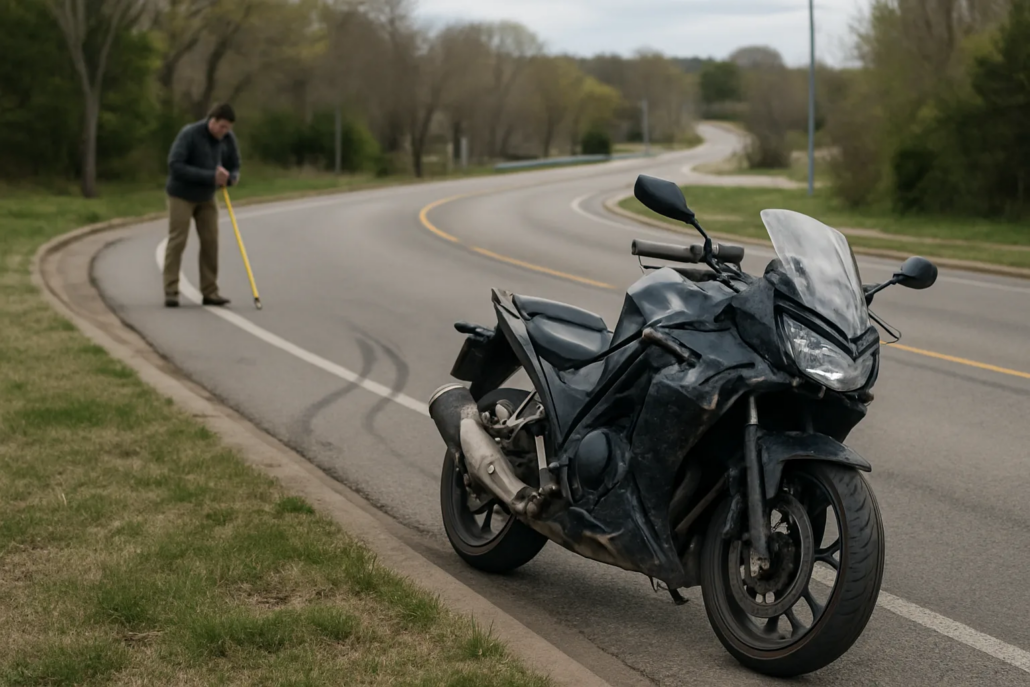
Scene photographs may show lane positions, sight distance, traffic controls, skid marks, debris, road slope, lighting, and the locations where vehicles came to rest. Helmet cameras, dashboard cameras, nearby security video, and photographs taken shortly after the crash may provide additional information. Vehicle damage can also help an appropriately qualified professional assess impact direction and the forces involved, although damage alone does not automatically establish speed.
The strongest evidence after an injury accident may include more than a police report. It can include original photographs, preserved video, witness contact information, vehicle inspection records, and physical evidence documented before conditions change. Evidence should be interpreted in context; a photograph of a damaged motorcycle does not, by itself, prove how fast it was traveling.
Reconstruction questions
A reconstruction analysis may examine reaction time, braking distance, available sight distance, roadway curvature, grade, traction, and the timing of each vehicle’s movement. It may also consider whether a rider had enough time and space to respond to a vehicle turning across the motorcycle’s path. These questions can be important when a witness offers only a general impression that the motorcycle was “going fast.”
How Do Road Conditions and Crash Mechanics Affect a Speed Dispute?
The location and mechanics of a Fayetteville, Arkansas crash may provide an alternative explanation for what a witness perceived. A motorcycle can lose control or travel a significant distance after a sudden maneuver without the rider having been traveling above the speed limit. Conversely, physical evidence may support an argument that speed reduced the rider’s available reaction time. The purpose of reconstruction is to test these possibilities, not to assume either one.
Could road conditions explain the crash?
Curves, hills, lane width, pavement seams, loose material, standing water, potholes, drainage problems, lighting, and blocked sight lines may affect a rider’s ability to perceive and avoid a hazard. Photographs and measurements should show the roadway from useful viewpoints, including the rider’s likely approach and the other driver’s line of sight. Conditions can change after a crash, so the timing and source of photographs may matter.
Fayetteville road-hazard evidence may be relevant when a roadway feature, rather than speed alone, is offered as an explanation for the crash. An investigation may consider whether a warning was present, whether a hazard was visible, and how the road’s geometry affected reaction time.
When braking or evasive action causes the crash
A rider may fall while braking or swerving to avoid another vehicle without making contact. Skid marks, tire evidence, vehicle locations, witness accounts, and available video may help show whether another driver’s movement caused an emergency response. The absence of contact does not automatically establish that the rider was speeding or eliminate the possibility that another road user contributed to the event.
That is why Arkansas no-contact motorcycle crash claims can require careful analysis of causation, lane position, timing, and evasive action. In a disputed case, a reconstruction professional may compare the competing accounts with the physical scene.
Which Records and Mistakes Matter After a Rider Is Blamed for Speeding?
A rider’s account is often evaluated alongside records created at different points in the aftermath. Consistency does not prove every detail, but contradictions can give an insurer or opposing party an argument about credibility. Prompt, accurate documentation may help preserve the factual record while memories and physical conditions are still changing.
Medical and police records
Emergency records, follow-up notes, ambulance observations, and reported symptoms may help establish when a rider described pain and how the injuries were connected to the crash. They do not determine vehicle speed, and medical records should not be treated as a reconstruction report. They may, however, address whether the rider’s account of the event and injury mechanism remained generally consistent.
Police records may contain statements, diagrams, measurements, citations, and observations from the scene. A police narrative is important evidence, but it is not necessarily the final word on disputed speed or fault. What injured Fayetteville riders should do after a crash includes practical considerations about reporting, documentation, and preserving information.
Common problems that can weaken a speed dispute
Depending on the circumstances, avoidable problems may include:
- Guessing about speed when speaking with witnesses, insurers, or investigators.
- Posting photographs or comments that omit important context about the crash.
- Allowing damaged motorcycle components, protective equipment, or video files to be discarded before they are documented.
- Waiting to identify witnesses or nearby cameras that may have limited retention periods.
- Ignoring road conditions, lighting, lane configuration, or another vehicle’s movement because the discussion focuses only on the alleged speed.
In Arkansas, an insurer may argue that a rider’s own conduct contributed to the injury. General comparative-fault principles can affect how responsibility and damages are evaluated, but the result depends on the facts and applicable law. Laws and procedures can vary by location and may change, so a Fayetteville rider may benefit from reviewing the evidence with an attorney before making statements or evaluating a claim.
A speeding allegation can also affect settlement discussions. Before evaluating a Fayetteville motorcycle accident settlement offer, a rider may need to understand how the offer accounts for disputed liability, documented losses, and the strength of the reconstruction evidence. A settlement decision is fact-specific and should not be based only on the first amount proposed.
Frequently Asked Questions
Does severe motorcycle damage prove the rider was speeding?
No. Severe damage can result from impact angle, the size and movement of another vehicle, the motorcycle’s design, road conditions, and what happened after the initial impact. Damage photographs and inspection records may help a qualified professional analyze the collision, but they do not automatically establish a particular speed. Other evidence, such as video, measurements, skid marks, and witness accounts, should be considered with the damage evidence.
Can a witness estimate speed accurately after a Fayetteville crash?
A witness may provide useful information about direction, timing, lane position, sound, or what occurred immediately before impact. However, a brief observation does not always establish a reliable numerical speed. Visibility, distance, lighting, attention, and the witness’s viewing angle can matter. Investigators and attorneys may compare the statement with physical evidence, video, vehicle damage, and roadway geometry rather than relying on an unsupported estimate alone.
What if the police report says the rider was speeding?
A police report may record an officer’s observations, witness statements, measurements, or a citation, and it can influence an insurer’s position. It may still be possible to examine whether the report distinguishes an observed speed from an estimate and whether later evidence provides additional context. A report is one part of the record, not necessarily a complete reconstruction of every timing and causation issue.
Does a speeding allegation end a motorcycle injury claim?
Not necessarily. The effect of an alleged speed depends on whether the evidence supports the allegation, whether speed contributed to the crash, and how responsibility is allocated under applicable Arkansas law. Other conduct, such as a vehicle’s unsafe turn or failure to yield, may also be relevant. A rider’s available claim and potential recovery depend on the complete facts, damages, insurance coverage, and legal deadlines.
How Elliot & Smith Law Firm Can Help
Elliot & Smith Law Firm is dedicated to helping Fayetteville riders examine the evidence behind a disputed motorcycle crash. The firm is committed to fighting for a clear understanding of photographs, video, scene measurements, vehicle damage, witness accounts, road conditions, and medical or police records. Depending on the circumstances, reviewing these details may help identify weaknesses in an unsupported speeding accusation or clarify issues that require further investigation.
If you were blamed for speeding after a motorcycle crash, contact Elliot & Smith Law Firm for a free consultation or case evaluation. The team is ready to evaluate your situation and discuss your legal options.
The information in this article is for educational purposes only and does not constitute legal advice. Contact a qualified attorney licensed in Fayetteville, Arkansas for advice specific to your situation.


