
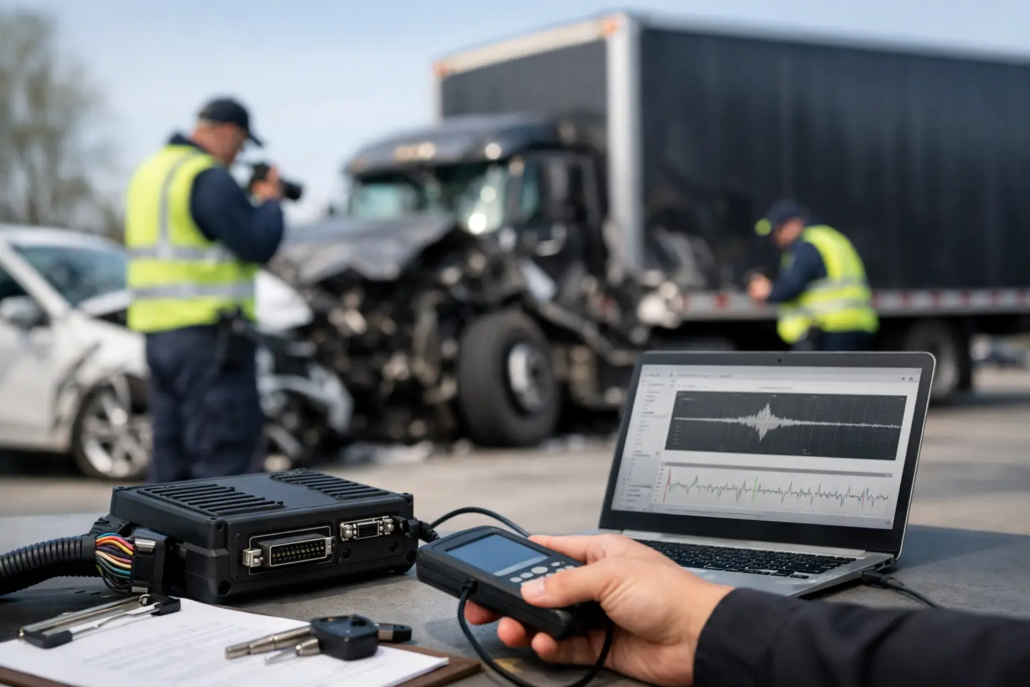
How Black Box Truck Evidence Can Prove a Crash
A violent truck crash can leave a family with unanswered questions while the trucking company moves quickly to protect itself. Black box truck evidence may hold some of the clearest answers: how fast the truck was traveling, whether the driver braked, whether the truck was accelerating, and whether a mechanical problem was detected before impact. That data can be powerful, but only if it is identified and preserved before it is overwritten, lost, or controlled by the wrong side of the case.
For an injured person, this is not a technical detail. It can be the difference between a trucking company’s version of events and evidence that shows what actually happened.
What Black Box Truck Evidence Can Show
Despite the name, a truck “black box” is not always one single device. Commercial trucks may contain an electronic control module, engine control module, event data recorder, or other onboard system that captures information about the truck’s operation. The exact data available depends on the make, model, age, and equipment installed in the vehicle.
After a significant collision, these systems may record a short window of information before and after the impact. A qualified expert may be able to retrieve data showing vehicle speed, brake application, throttle position, engine RPM, clutch use, cruise-control status, and sudden deceleration. In some cases, the data can also reveal fault codes or warnings connected to the truck’s mechanical condition.
That evidence may directly challenge a claim that the truck driver had no time to react. If the data shows no braking before impact, for example, investigators may look more closely at distraction, fatigue, following too closely, or a driver who failed to recognize stopped traffic. If it shows the truck was traveling faster than the driver reported, that can change the entire liability analysis.
Still, black box data is not magic. It does not always show why a driver failed to brake or whether a driver was looking at the road. It must be read correctly, compared with the physical crash scene, and evaluated alongside other records. A strong truck accident claim is built on the full picture, not one data point viewed in isolation.
Why This Evidence Can Disappear Fast
Trucking companies usually take control of their vehicles soon after a crash. The truck may be moved, repaired, returned to service, or inspected by company representatives and insurance investigators. Electronic data can also be overwritten as the truck continues operating. Some systems preserve crash events, while others have limited storage or require prompt downloading.
The company and its insurer are not required to build your case for you. Their early investigation may focus on limiting their financial exposure. That is why an injured person should not wait for an insurer to decide what evidence matters.
A lawyer can send a formal preservation demand that identifies the truck and requests that key materials not be destroyed or altered. Depending on the facts, that request may cover onboard electronic data, the truck itself, driver logs, dispatch communications, GPS records, inspection reports, maintenance files, dash camera footage, driver qualification records, and post-crash testing.
Preservation requests do not guarantee cooperation, but they create a clear record that evidence was requested. If a company destroys relevant materials after receiving notice, that conduct can become a serious issue in the claim or lawsuit.
The Questions Truck Data May Help Answer
In a serious crash, the first version of events is often incomplete. Witnesses are shaken. Drivers may remember only seconds before impact. Police officers must make quick decisions at a chaotic scene. Truck event data can help investigators test critical questions rather than relying on assumptions.
It may help establish whether the truck was speeding into congestion, whether the driver attempted to brake, how abruptly the truck slowed, or whether the vehicle was under power at the moment of impact. It may also help experts reconstruct the truck’s movement and compare it against skid marks, vehicle damage, photographs, roadway conditions, surveillance video, and witness statements.
The value of the data depends on context. A recorded speed alone does not automatically prove fault. A truck might be traveling below the posted limit but still too fast for rain, darkness, construction traffic, or stopped vehicles ahead. Likewise, evidence of braking does not automatically clear a driver. The key question is whether the driver acted reasonably under the circumstances and followed the safety rules that apply to commercial trucking.
Black Box Data Is Only Part of the Case
Trucking cases often involve more than driver error. A driver may have been pushed to meet an unrealistic delivery schedule. The company may have ignored hours-of-service rules, failed to maintain brakes or tires, hired an unsafe driver, or allowed a truck with known mechanical issues onto Arkansas roads.
That is why lawyers should pursue the records surrounding the truck’s electronic data. Electronic logging device records can show driving and rest time. Dispatch messages can reveal schedule pressure. Maintenance records may show whether the truck had recurring safety problems. GPS data can confirm the truck’s route and timing. Camera footage, when available, may capture the driver’s actions or traffic conditions in ways that a data recorder cannot.
These records can either support or contradict the trucking company’s story. They also help identify every party that may be responsible, including the driver, motor carrier, maintenance provider, cargo handler, or another business involved in the truck’s operation. Which parties belong in a claim depends on the evidence, and quick assumptions can leave compensation on the table.
What to Do After a Truck Crash
Your health comes first. Get emergency care, follow your medical providers’ instructions, and keep records of every diagnosis, treatment, missed workday, and out-of-pocket cost. Serious injuries may worsen after the initial shock wears off, so do not minimize pain simply because you were able to leave the scene.
If you can do so safely, preserve what is in your control. Save photos of the vehicles, roadway, visible injuries, and debris. Keep the other driver’s information, the police report number, and contact details for witnesses. Do not post speculation about the crash on social media, and be cautious about giving a recorded statement to the trucking company’s insurer before you understand your rights.
Then speak with a truck accident attorney as soon as possible. The goal is not to rush you into a decision. The goal is to put someone in your corner while evidence is still available and while you are trying to recover.
Do Not Let the Carrier Control the Story
Trucking companies have investigators, insurers, and legal teams who know how high the financial stakes can be after a catastrophic collision. You deserve a team prepared to demand the records, examine the truck data, challenge weak explanations, and fight for compensation that accounts for medical care, lost income, pain, disability, and the harm done to your family.
At Elliott & Smith Law Firm, we help injured Arkansans take the burden off their shoulders and put the pressure where it belongs: on the parties responsible for the crash. A free consultation can help you understand the evidence that may exist, the deadlines that may apply, and the next move needed to protect your claim.
When a truck crash changes your life, the evidence should not disappear before your voice is heard.


